Central Politburo of the Communist Party of the Soviet Union
A Gentleman in MoscowThe Central Politburo of the Communist Party of the Soviet Union is presented as both a political institution and a measure of changing power: a body whose membership and internal balance matter, while its influence extends into public culture and the administration of everyday life. The novel places its history alongside the First Five-Year Plan, the removal of Nikolai Bukharin, and the growing reach of state authority, making the body part of a transformation that reaches far beyond its formal political setting.
Identity and Historical Position
The narrative identifies the Central Politburo of the Communist Party of the Soviet Union through decisive changes in its composition and authority. On November 17, 1929, Nikolai Bukharin, described as a founding figure, editor of Pravda, and the last true friend of the peasantry, was outmaneuvered by Joseph Stalin and removed from the body. The account treats this defeat as a turning point: it cleared the way for a return to autocracy in all but name.
The removal is set within a compressed chronology of transformations. The First Five-Year Plan began on January 3, 1928, with the stated aim of moving Russia from an agrarian society into an industrial power. The drafting of Article 58 of the Soviet Criminal Code on February 25, 1927, is identified as another consequential date, associated with a legal net that would eventually ensnare the population. These developments are not presented as actions of the Central Politburo alone; together, however, they establish the political world in which its changing authority acquires significance.
Membership and Political Balance
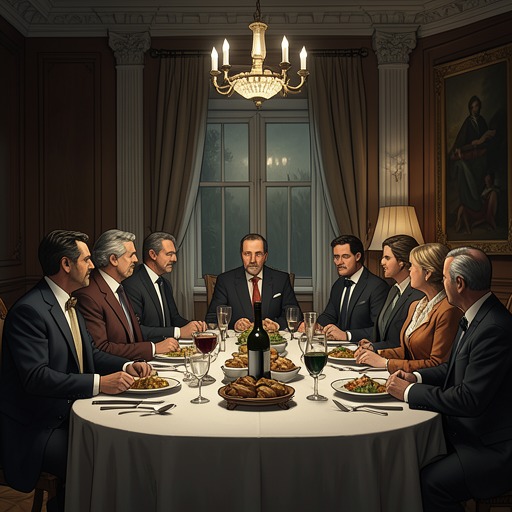
The body’s internal distinctions become visible in a practical question of rank and treatment. At the Boyarsky, two members of the Central Politburo were hosting tables during the restaurant’s second seating. Both were relatively new to their positions, so neither required the best table. What mattered was that they receive identical treatment: equal attention, tables of equal size, and positions equally distant from the kitchen door. Ideally, they would sit on opposite sides of the centerpiece, an arrangement of irises.
The episode makes political equality a matter of exact spatial and procedural balance. The reservations list contains no unusual crisis, yet the placement of two comparatively new members demands careful judgment. The restaurant’s service arrangements turn abstract standing into measurable details—distance, table size, attention, and position—showing how political hierarchy can enter even the planning of a dinner.
Political Authority and Public Culture
The novel also shows political power operating through signals that need not take the form of a formal order. At a Moscow premiere of a film starring Anna Urbanova, Joseph Stalin did not smile as wholeheartedly as he had at earlier films. The audience noticed: enthusiasm in the orchestra section diminished, then spread downward through the mezzanine and balcony, until the house sensed that something had changed.
Two days later, an ambitious apparatchik published an open letter in Pravda criticizing the director’s return to princes, princesses, candlelight, and marble stairs, as well as the films’ emphasis on individual stories rather than collective struggle. Four days after the letter appeared, Joseph Stalin approached its author before addressing the Plenum and complimented his phrasing. Two weeks after the Plenum, the letter’s arguments and some of its language appeared in three more newspapers and an arts journal. The film was restricted to second-rate theaters, and the director’s political reliability came into question. The episode does not describe a formal resolution by the Central Politburo; instead, it depicts a political climate in which a leader’s visible reaction can set the direction for criticism and distribution.
State Transformation and Narrative Significance
The First Five-Year Plan’s industrial ambition depended on changes in the countryside as well as the cities. The narrative describes the exile of a million kulaks, many of them among the regions’ most capable farmers, followed by peasant suspicion of new agricultural methods, shortages of tractors, poor weather, and declining harvests. Despite the falling output, grain quotas and requisitions increased and were enforced at gunpoint. By 1932, these forces had produced widespread hardship in the agricultural provinces and starvation deaths among millions of peasants in Ukraine. The account supplies this chain of consequences as the human context of state transformation, not as a policy explicitly attributed to the Central Politburo.
In the novel’s historical framing, the body matters because political change is made legible through concrete shifts: Bukharin’s removal, the altered balance of authority, the calibrated treatment of its members, and the spread of political signals into cultural life. Its significance lies not only in who holds a position, but in the ways political authority reaches outward—from elite status and public criticism to administrative demands imposed on the countryside.